I need a toilet...
Reasons for disconnecting your toilet system from the water grid were briefly touched on in my first post. I'll go into more detail on this in a future post for anyone interested in learning more about the environmental impact of flush-toilets. The purpose of this post is to discuss some of the options available for off-grid toilet systems, and to explain why I opted for the system I'm now using. I won't be covering chemical toilets or incineration-based systems due to their obvious environmental cost. If you're short on time, or if learning about the variety of off-grid toilet systems doesn't excite you, skip to the end to read about my off-grid toilet-system-of-choice.
Hole-in-the-ground/long-drop/pit latrine
Whatever you call it, this simple system involves creating a toilet whose contents drop into a hole dug directly into the ground. This system may or may not have a toilet seat above the ground, and may also include a fan for ventilation. The 'hole' may have a permeable lining (such as bricks), or a waterproof lining, or no lining at all. If a waterproof lining is used, or if the hole is not very deep, then its contents will need to be removed manually once it fills up. Either way, the toilet will eventually need to be moved or emptied out as the material cannot all be absorbed into the ground.
Pit latrines were popular in the UK from the early to the mid-1800s, when they started to be replaced by modern flush-toilets (you can read more about the reasons for this transition here). Data from 2024 suggests that around 20% of the world's population uses pit latrines, while over 5% don't have access to any kind of toilet system.
The environmental impact of a pit toilet depends largely on how it's constructed and what is done with its contents. If the toilet is not lined with a watertight lining or is poorly maintained, then both environmental and human-health concerns associated with groundwater contamination arise. Even if the toilet is well-maintained and watertight, the spread of disease via insects and rodents remains a serious concern.
If the toilet contents are removed and composted above-ground, then the toilet could also be called a composting toilet (more on composting toilets below). However, if the contents are left in the ground, or extracted and buried elsewhere, then this is not a composting toilet. True composting requires the presence of oxygen and so cannot take place underground. Burying nitrogen-rich material such as fecal sludge under the ground is in fact terrible for the environment as its (anaerobic) decomposition releases methane gas, a potent greenhouse gas.
Cesspit
Cesspits are sealed tanks used for the temporary storage of wastewater. The toilet itself may be either a flush-toilet or a chemical toilet. Once the cesspit is full, it must be emptied and its contents processed elsewhere. These systems were recently made illegal in Scotland due to concerns about leakage. Cesspit systems are still commonly used in rural properties and on campsites across the rest of the UK, although installing a new one requires planning permission. Due to the mixing of grey water (wastewater from sinks, baths and showers) and black water (wastewater from toilets), the material is unlikely to be suitable for composting. As best I can tell, in the UK the contents of cesspits are typically transported to the closest available connection to the underground sewer network.
Septic tank
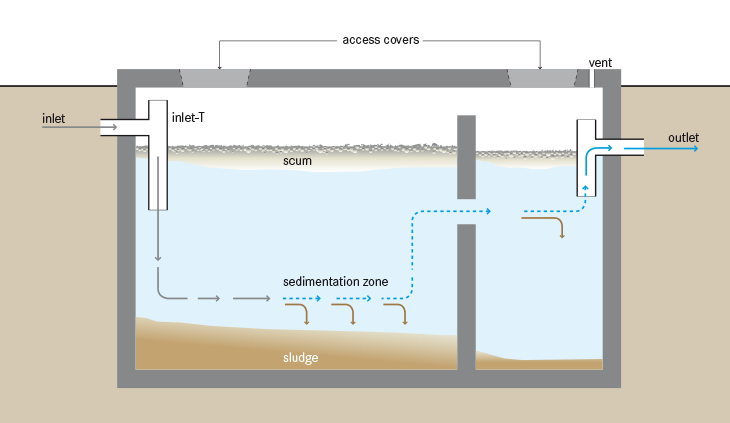
A septic tank is a kind of miniature water treatment plant for processing the wastewater of a single property. As with a cesspit system, the wastewater is collected into a large container. In a septic tank, the wastewater then undergoes some simple processing, with the resulting liquid then being discharged into the ground or a nearby water source.
There are a variety of septic tanks with different wastewater processing methods available on the market. The most basic option simply separates the solids from the liquid via gravity, and then discharges the liquid directly into the ground nearby. Incredibly, these basic systems are legal in all countries within the UK. From an environmental perspective, this is obviously a disaster. The author of The Humanure Handbook writes about the impact of pollution from septic tank systems in the US: "The Indian River Lagoon in Florida receives about a million and a half pounds of nitrogen annually from...surrounding septic systems."
Composting Toilet
The Holy Grail of off-grid toilet systems is without a doubt the composting toilet. A composting toilet is a dry (non-flush) toilet system whereby the material collects directly into a watertight container. Once the container is full, its contents can be added to a compost pile. Once the composting process is complete, the compost can then be used like any other compost to grow shrubs, trees or vegetables. No methane, no groundwater pollution, no smell.
To learn more about the benefits and workings of composting toilets, I highly recommend reading Joseph Jenkins' The Humanure Handbook. Joseph has also written a digital condensed version of his handbook and made it available to download for free here.
A couple of weeks ago, I installed a Simploo Original composting toilet in my home bathroom. In a future post I'll write about why I chose this model, how I set it up, and how it's going so far. I will also write about the pros and cons of 'separating' composting toilets which separate the solids and liquids into different containers. Comment below if you have any questions about composting toilets or off-grid toilet systems in general and I'll do my best to answer them in future posts.
That's all for now, thanks for reading.
Jess